&geometry(294x90) "KMG Communications")
Sports Supplements 2: Supplement contamination – What athletes need to know
)
Imagine buying a sports supplement from a legitimate retailer. You check the label. There is nothing obviously concerning in the ingredient list. You take the recommended dose and think no more about it. Except the product contains a substance prohibited in sport - and that substance isn't listed anywhere on the packaging. It might sound unusual, however recent Australian research - and an active regulatory crackdown playing out in real time - suggests otherwise.
Two-part ‘Sports Supplement’ series
This is Part 2 of a two-part series from KMG Communications for Heart Health for Athletes on sports supplements. Sports supplements can contain substances prohibited in sport, sometimes without those substances appearing on the label. For competitive athletes, this creates a risk of inadvertent doping. Understanding how supplement contamination occurs, which products carry greater risk and how independent batch testing works can help athletes make safer, more informed choices.
Part 2 Sports Supplements: Supplementation contamination - What athletes need to know
In this article:
- What Australian testing is telling us
- Regulation and quality control
- The peptide problem
- How does contamination happen?
- Keep the risk in perspective
- What happens if a prohibited substance is detected?
- Athlete cases
- Reducing your risk
- A practical approach for athletes
1. What Australian testing is telling us
In 2022, Sport Integrity Australia commissioned Human and Supplement Testing Australia (HASTA) to analyse 200 non-batch-tested (uncertified) sports supplements from the Australian online marketplace. The results, released in 2025, were concerning: 35% contained a substance prohibited by the World Anti-Doping Agency (WADA), and 57% of those didn't disclose it on their packaging or website (Barker et al. 2025).
This doesn't mean one-third of all sports supplements are contaminated - the study focused on higher-risk, non-batch-tested categories. But it makes an important point: reading the label may not tell you everything contained in a supplement.
2. Regulation and quality control
Sports supplements don't all fall into a single regulatory category in Australia - depending on ingredients, presentation and claims, they may be regulated as “foods” or “therapeutic goods”, with different manufacturing and labelling requirements.
For athletes, that's an important distinction: legal, safe and permitted in sport are not necessarily the same thing. A product being legally available doesn't mean the specific batch has been independently tested for substances prohibited by WADA.
3. The peptide problem
The peptide market currently playing out in Australia makes this concrete. Peptide hormones and growth factors are prohibited by WADA at all times. Many of the products flooding the black market right now are also unlawful under Australian therapeutic goods law.
In June 2026, the TGA named unapproved peptides a formal compliance priority, citing a sharp rise in imports and supply. Joint operations with the Australian Border Force and state police have since seized peptides and other performance drugs worth more than $2 million, with arrests and raids across Victoria and New South Wales as recently as August 2026.
Despite that crackdown, these products remain easy to find online, frequently labelled as “research chemicals” to distance sellers from their real purpose.
Independent testing this year through the University of Queensland found counterfeit vials of a popular black-market weight-loss peptide were inconsistently dosed, some considerably stronger than labelled. For an injectable product, that unpredictability carries serious health risk separate from any anti-doping consequence - and it reflects the same underlying problem as the HASTA findings: you cannot assume a product contains what it claims simply because it's readily available or professionally packaged.
4. How does contamination happen?
One route is cross-contamination during manufacturing, where shared equipment and ingredient suppliers mean traces of one product can find their way into another. In other cases, prohibited substances are deliberately included but not declared, particularly in products promising rapid muscle gain or fat loss. Other products simply don’t contain what’s claimed, using cheaper filler ingredients instead.
Irrespective of the type of contamination, the athlete faces the same problem: the product may contain something they don't know they're taking.
5. Keep the risk in perspective
None of this means supplements are inherently unsafe, or manufacturers should automatically be viewed with suspicion — many take quality seriously. But ordinary quality control isn't the same as independently testing a specific batch, and some products are riskier than others.
In Sports Integrity Australia’s 2022 testing, prohibited substances were detected in 53% of muscle-building products, 49% of fat burners and 34% of pre-workout supplements tested. Strong claims about muscle growth, weight loss or stimulation warrant particular caution - and remember, “natural” doesn't necessarily mean anti-doping safe.
6. What happens if a prohibited substance is detected?
When anti-doping analysis detects a prohibited substance, the laboratory may report an Adverse Analytical Finding (AAF) - which tells us a substance was detected, not how it got there. Under strict liability, athletes are ultimately responsible for what's found in their bodies. Intent doesn't have to be established for a violation to occur, though source and degree of fault can still affect the outcome. This is why suspected supplement contamination gets complicated, as the following cases show.
7. Athlete cases
Simona Halep (2022-2024): Former world No. 1 tennis player, Simona Halep, tested positive for roxadustat (Evrenzo) at the 2022 US Open. CAS accepted contamination as the likely source but found the quantity she had reported taking couldn't fully explain the concentration detected, reducing her four-year ban to nine months. Lesson: an accepted contamination explanation doesn't automatically mean no sanction.
Issam Asinga (2023-2025): Teenage sprinter, Issam Asinga, blamed a positive test for GW1516 (Cardarine or Endurobol) on contaminated “recovery gummies” from a gift bag. The Athletics Integrity Unit wasn't persuaded; CAS upheld his four-year ban in 2025. Lesson: suspecting contamination and proving it are not the same thing.
Shayna Jack (2019-2021): Australian swimmer Shayna Jack returned an AAF for LGD-4033 (Ligandrol) in 2019. The source was never established, but an arbitrator found her ingestion unintentional and reduced her sanction from four years to two, upheld by CAS. Lesson: not being able to prove the source doesn't mean you're assumed guilty — but the unresolved uncertainty still carries a real cost.
Together, these cases show how hard an AAF can be to unwind after the fact, whether or not contamination is ultimately accepted.
8. Reducing your risk
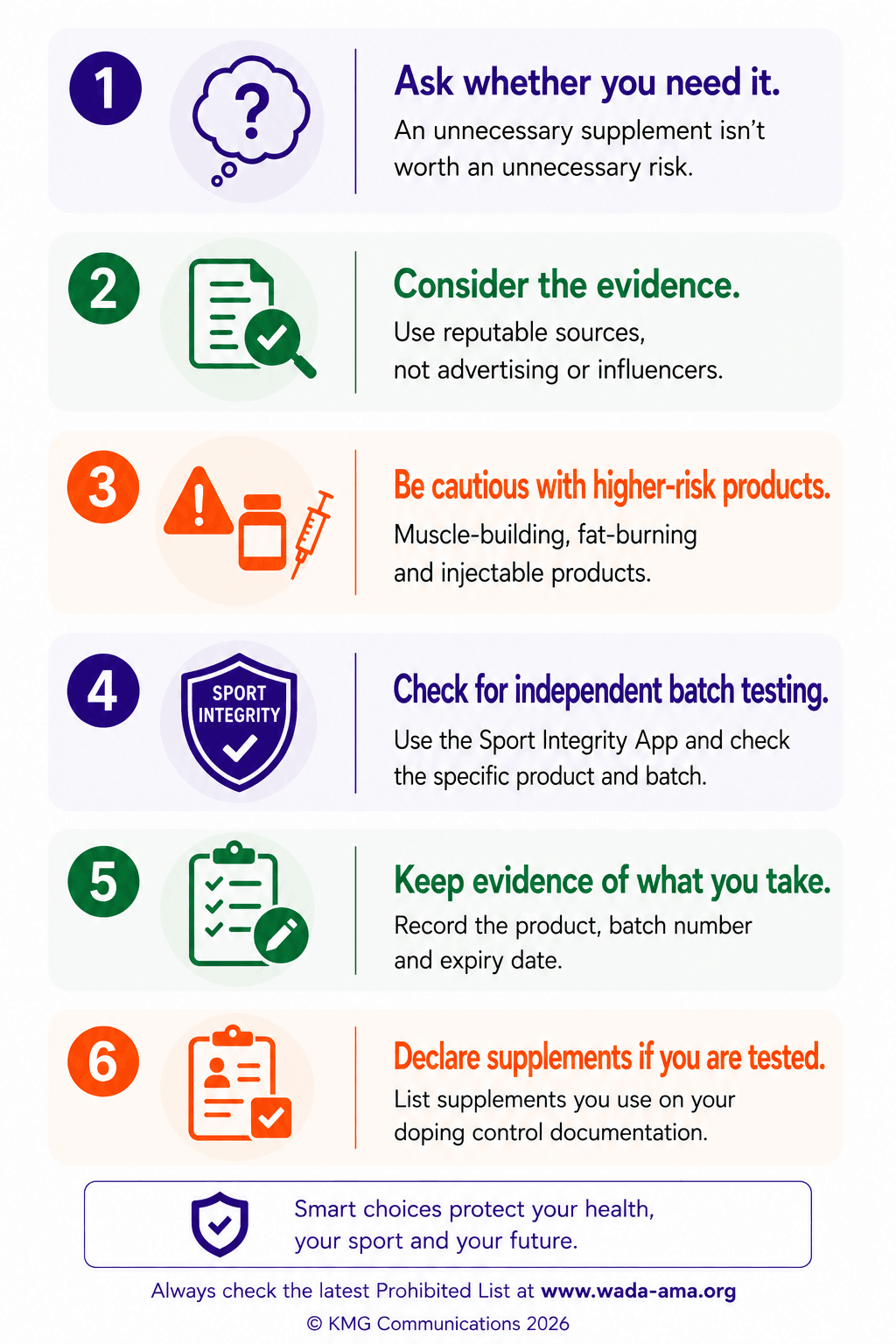
No supplement can be guaranteed 100% safe from an anti-doping perspective, but independent batch testing - through programs like HASTA and Informed Sport - is the most important safeguard.
Use the Sport Integrity App to identify supplements that have undergone independent batch testing.
Check the specific product and batch, not just the brand. Sport Integrity Australia recommends the Sport Integrity App for this. None of the current black-market peptide products carry any batch testing or TGA approval - which is exactly why they're highest-risk.
Reading labels remains sensible but isn't a complete safeguard - claims like “athlete safe” or “natural” shouldn't replace independent checking, especially given 57% of contaminated products in the HASTA 2022 testing didn't disclose it on the label.
9. A practical approach for athletes
Make supplementation choice a far more informed decision - and help protect both your health and your sport. Don't just ask: "What's on the label?", before using a sports supplement:
--
Sports Supplements 1: Part 1 of the Sports Supplements series consideres what counts as a sports supplement, when they're worth using, and how anti-doping rules intersect with supplementation. Read more at: Sports Supplements 1: What are you taking and do you really need it?
--
Frequently Asked Questions (FAQs)
Sports supplement contamination
Q: Can sports supplements contain banned substances that aren't on the label?
A: Yes. Sports supplements can contain substances prohibited by WADA that aren't declared on the product label. This may result from manufacturing contamination or the presence of an undeclared ingredient. Recent Australian testing found that 57% of products testing positive for prohibited substances did not disclose those substances on their packaging or website.
Q: Can a contaminated supplement cause a positive drug test?
A: Yes. If a contaminated supplement contains a prohibited substance, an athlete may return an Adverse Analytical Finding (AAF). Under anti-doping rules, athletes are ultimately responsible for prohibited substances found in their bodies, even when ingestion was unintentional.
Q: Which sports supplements have the highest contamination risk?
A: Muscle-building, fat-burning and pre-workout products are considered higher-risk categories. In recent Australian testing, prohibited substances were detected in 53% of muscle-building products, 49% of fat burners and 34% of pre-workout supplements tested. Injectable peptide products, currently the subject of an active TGA compliance crackdown, are considered particularly high-risk.
Q: Are the illegal peptides in the news the same issue as supplement contamination?
A: They're closely related. Peptide hormones and growth factors are prohibited by WADA, and many peptide products sold on Australia's black market are also unlawful under Australian therapeutic goods law. Independent testing in 2026 found dosing in these products to be highly inconsistent with the label, underlining that black-market products carry both legal and health risks that go beyond anti-doping consequences alone.
Q: How can athletes reduce the risk of supplement contamination?
A: Athletes can reduce their risk by using only supplements that have undergone recognised independent batch testing, checking the specific product and batch, avoiding higher-risk products where possible, and keeping records of the supplements they use.
Q: What is a Therapeutic Use Exemption (TUE)?
A: A TUE is permission for an athlete to use an otherwise prohibited substance or method for a legitimate medical reason. Athletes should never stop necessary medication because of anti-doping concerns; instead, they should check the medication's status and seek appropriate medical and anti-doping advice.
Q: Does batch testing guarantee that a sports supplement is safe?
A: No. Independent batch testing cannot guarantee that a supplement is completely free from prohibited substances, but it substantially reduces the risk. Australian athletes can use the Sport Integrity App https://www.sportintegrity.gov.au/for-you/view-all-resources/sport-integrity-app to identify products that have undergone recognised independent batch testing.
Q: What should an athlete record when taking supplements?
A: Athletes should record the product name, specific batch number and expiry date and retain relevant packaging or records where practical. Supplements should also be declared on doping control documentation if an athlete is tested.
--
References
ABC News (2026, 10 June). Illegal peptides are everywhere. Now authorities are cracking down. https://www.abc.net.au/news/2026-06-10/peptide-tga-regulation-crackdown/106781680
ABC News (2026, 28 August). New testing of black-market peptides reveals dangerous dosing levels. https://www.abc.net.au/news/2026-08-28/black-market-peptides-dangerous-doses/107059092
Barker L, Cawley A, Speers N, Knowler K, Chilman K. Sports Supplement Analysis Survey for the Prevalence of WADA Prohibited Substances in the Australian Online Marketplace. Drug Test Anal. 2025 Oct;17(10):1857-1864. doi: 10.1002/dta.3893. https://pmc.ncbi.nlm.nih.gov/articles/PMC12489291/
Court of Arbitration for Sport (2024, 5 March). CAS reduces Simona Halep's period of ineligibility to nine months. Reported in Malay Mail, https://www.malaymail.com/news/sports/2024/03/05/court-of-arbitration-for-sport-cuts-haleps-doping-ban-from-four-years-to-nine-months/121643
ESPN (2025, 30 October). CAS upholds sprinter's ban, rejects 'recovery gummies' defense. https://www.espn.com/olympics/trackandfield/story/_/id/46786272/cas-upholds-sprinter-ban-rejects-recovery-gummies-defense
Human and Supplement Testing Australia (HASTA) (no date). Supplement testing. https://hasta.org.au/supplement-testing/
Lopes S, Cunha M, Fernandes AS, Oliveira NG, Ferreira-Pêgo C, Costa JG. Contamination and adulteration of food supplements: Risk perception and regulatory awareness in recreational athletes. Regulatory Toxicology and Pharmacology. 2026 Aug;169:106106. doi: 10.1016/j.yrtph.2026.106106. https://pubmed.ncbi.nlm.nih.gov/42025870/
Maughan RJ. Contamination of dietary supplements and positive drug tests in sport. J Sports Sci. 2005 Sep;23(9):883-9. doi: 10.1080/02640410400023258. https://pubmed.ncbi.nlm.nih.gov/16195040/
Sport Integrity Australia (no date). Supplements in sport. https://www.sportintegrity.gov.au/what-we-do/anti-doping/substances/supplements-sport
Therapeutic Goods Administration (2026). TGA strengthens compliance focus on unapproved peptide products as part of evolving risk response. https://www.tga.gov.au/news/media-releases/tga-strengthens-compliance-focus-unapproved-peptide-products-part-evolving-risk-response
Therapeutic Goods Administration (2026). TGA flexes its muscle against illegal peptides and steroids. https://www.tga.gov.au/news/media-releases/tga-flexes-its-muscle-against-illegal-peptides-and-steroids
Wardenaar, F. C., Burns, S. F., Campos, M., Chan, Y., Claassen-Smithers, A., Dunshea-Mooij, C., Haddou, S. E., Hoogervorst, D., Jagim, A., Garcia, P. R., Garthe, I., Nugent, A. P., Aly, M. O., Saunders, B., Schott, K. D., Sekiguchi, Y., Slater, G., Speers, N., Stratton, M. T., & Aussieker, T. (2026). Navigating the risks beyond the label: Unpacking global nutritional supplement safety. International Journal of Sport Nutrition and Exercise Metabolism, 36(2), 134-166. https://doi.org/10.1123/ijsnem.2025-0177
)
| Tags:Heart Health for AthletesHH4A Heart Health for Athletes |