&geometry(294x90) "KMG Communications")
Sports Supplements 1: What are you taking and do you really need it?
)
Two-part ‘Sports Supplement’ series
This is Part 1 of a two-part series from KMG Communications for Heart Health for Athletes on sports supplements. As Australian authorities crack down on illegal black-market peptides, we unpack what counts as a sports supplement, what the evidence really says, and where anti-doping rules come in.
Part 1 Sports Supplements: What are you taking and do you really need it?
In this article:
- Why sports supplements are under the spotlight
- What is a sports supplement?
- Do supplements work?
- Why take supplements?
- Evidence versus marketing
- What supplements are prohibited substances?
- Therapeutic Use Exemption (TUE)
- Four questions to ask before taking a supplement
- In summary: Putting supplements into perspective
1. Why sports supplements are under the spotlight
In June 2026, the Therapeutic Goods Administration (TGA) named unapproved peptides a formal compliance priority, citing a sharp rise in imports, advertising and supply. Since then, joint operations with the Australian Border Force and state police have seized peptides, illicit steroids and other performance and image-enhancing drugs worth more than $2 million, with arrests and search warrants in Victoria and New South Wales.
Do I need it? Does it work? Is it safe? And do I know what I am actually taking?
These products are promoted heavily on social media and sold through marketplace channels, often mislabelled as “research chemicals” not for human use - a disclaimer that looks designed to dodge liability rather than describe how they're actually used. Independent testing of black-market weight-loss peptides this year found some vials far more concentrated than labelled, a risk researchers described as more dangerous than under-dosing. It's a stark example of a problem that extends well beyond peptides and well beyond the black market.
2. What is a sports supplement?
The category is broader than vitamins in a bottle - it spans protein powders, sports drinks and gels, electrolyte products, creatine, caffeine and more, marketed for performance, recovery or general health. Some simply offer a convenient way to meet nutritional needs, such as a gel providing carbohydrate during a long session; others target a specific deficiency or performance effect.
3. Do supplements work?
There is no single answer to this question. Some do - when used for the right reason and in the right way. Others have limited or emerging evidence, while some have little evidence of meaningful benefit.
Supplements can have a legitimate role.
The Australian Institute of Sport (AIS) recognises supplements can play a small but valuable role in an athlete's nutrition plan. Its Sports Supplement Framework (the AIS ABCD classification) rates products by the scientific evidence supporting their use, alongside safety and whether they are permitted in sport.
Group A of the AIS ABCD classification is the highest evidence tier and includes:
- Sports drinks, gels, electrolyte products and protein supplements
- Medical supplements such as iron, calcium and vitamin D when clinically indicated
- Performance supplements including caffeine, creatine, beta-alanine, dietary nitrate and sodium bicarbonate.
This doesn't mean every athlete should be taking them. It means there is evidence of benefit when a particular product is used for a particular purpose and according to an evidence-based protocol.
4. Why take supplements?
Start with the problem, not the product. Rather than asking, “Which supplements should I be taking?”, a better starting point is:
What am I trying to achieve?
- Do I have an identified nutritional deficiency?
- Am I struggling to consume enough carbohydrate during a long event?
- Is it difficult for me to access appropriate food after training?
Has a product simply appeared repeatedly in your social media feed and prompted you to try it? For example, consider protein: it's important for recovery, but that doesn't mean every athlete needs protein powder when food can often do the job just as well.
5. Evidence versus marketing
Evidence and marketing are not the same thing. The real question isn't whether supplements work in general, but:
Is a particular ingredient - at an appropriate dose and used in an appropriate way - likely to benefit you?
Supplement marketing is a large, sophisticated industry, promising energy, recovery, strength and fat loss — often backed by scientific-sounding language and influencer endorsement, the same playbook now selling unapproved peptides online. But marketing claims aren't scientific evidence. The AIS ABCD system usefully distinguishes supplements with strong evidence (A), emerging evidence (B), no convincing evidence (C), and those that are prohibited or high-risk for contamination (D).
6. What supplements are prohibited substances?
This is where supplementation intersects with anti-doping. The World Anti-Doping Agency (WADA) Prohibited List covers far more than substances associated with deliberate cheating. It includes the following categories.
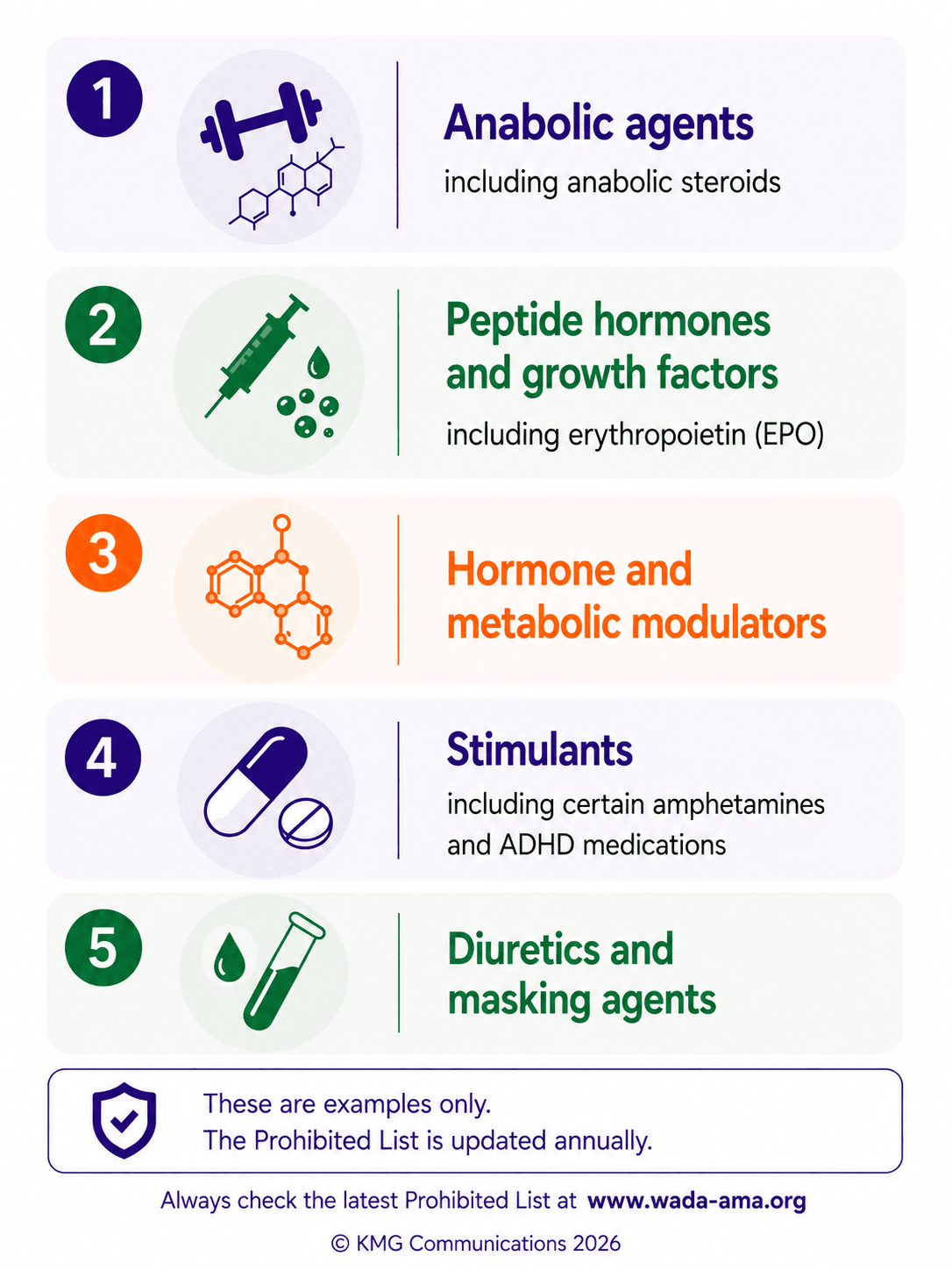
Prohibited methods, such as manipulation of blood or blood components, commonly referred to as blood doping are also banned.
Some substances are banned at all times, others only during competition or in certain sports.
Peptide hormones and growth factors are exactly the category now dominating Australian headlines. The products at the centre of the TGA's current crackdown - marketed for muscle building, fat loss and anti-ageing - fall squarely within a class prohibited in sport at all times, regardless of whether it is also unlawful to import or sell the specific products.
7. Therapeutic Use Exemption (TUE)
What’s prohibited in sport isn't necessarily illegal. A substance can be prohibited in sport without being an illegal drug - some are legitimate medications, and a prescription doesn't automatically mean a medication is permitted in competition. If a prohibited medication is medically necessary, an athlete may need a Therapeutic Use Exemption (TUE) - never stop necessary medication over anti-doping concerns without seeking advice first.
Black-market peptides sit at the opposite extreme: many are both prohibited in sport and unlawful to import, advertise or supply, since they've never been assessed by the TGA for safety or effectiveness. For a consumer or athlete, illegal, prohibited and untested is about as high-risk as a product category gets. There's also a broader health consideration:
Anabolic steroids, stimulants and manipulation of red blood cell levels can carry serious risks.
Knowing what you're taking isn't only about anti-doping compliance; it's also about understanding what a substance may be doing to your body while you train and compete.
8. Four questions to ask before taking a supplement
Before deciding to use a supplement, come back to four questions:
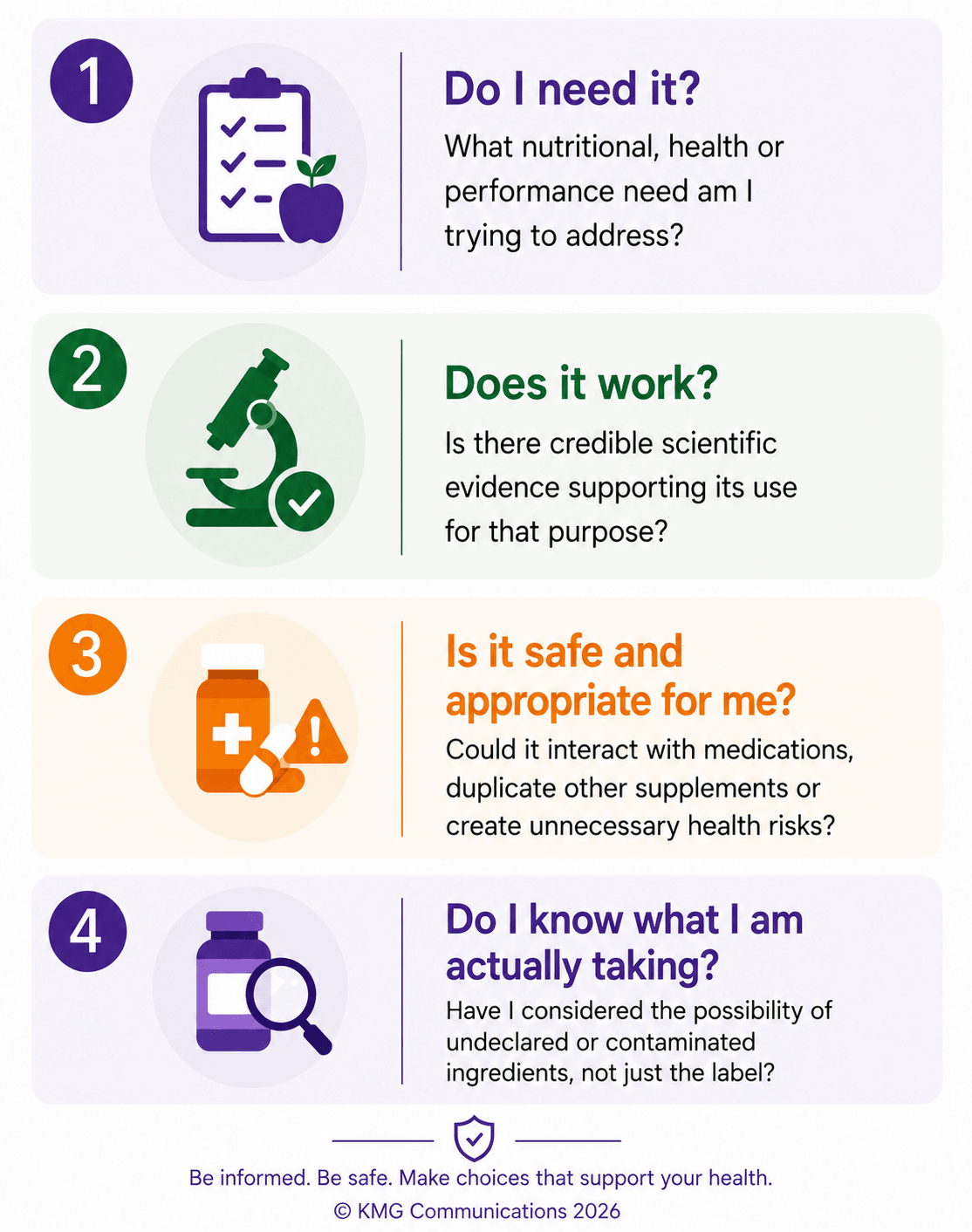
That final question is particularly important for competitive athletes - and, as the current peptide crackdown shows, for anyone buying performance or image-enhancing products online. Some categories of supplements carry considerably greater risk than others.
9. In summary: Putting supplements in perspective
Given the complexities involved, a food-first approach remains a sensible foundation for sports nutrition. Whole foods provide combinations of nutrients that can't easily be replicated in isolation. Supplements can then be used selectively, where there's identified need or good evidence - and an Accredited Sports Dietitian can help work out if a more specialised product is warranted.
--
Sports Supplements 2: Part 2 of the Sports Supplements series considers supplement contamination more closely - how supplement contamination happens, which products carry the greatest risk, and how independent batch testing works. Read more at: Sports Supplements 2: Supplement contamination - What athletes need to know
--
Frequently Asked Questions (FAQs)
Sports Supplements: What are you taking and do you really need it?
Q: What counts as a sports supplement?
A: A much broader category than most people expect. It includes vitamins and minerals, protein powders, sports drinks and gels, electrolyte products, creatine, caffeine products and other substances marketed for performance, recovery or general health; in other words, not just pills and powders sold specifically as “supplements”.
Q: Do sports supplements actually work?
A: It depends on the product and the purpose. Some supplements have strong scientific evidence supporting their use in specific situations, others have limited or emerging evidence, and some have little evidence of meaningful benefit. The right question isn't whether supplements work in general, but whether a specific ingredient, at an appropriate dose, is likely to benefit you for a specific need.
Q: What is the AIS Sports Supplement Framework?
A: Also referred to as the AIS ABCD classification system, the AIS Sports Supplement Framework classifies sports foods and supplements according to the scientific evidence supporting their use, alongside safety and whether they're permitted in sport. Its highest evidence category, Group A, includes products such as sports drinks, electrolytes, protein supplements, caffeine, creatine and certain medically indicated products like iron or vitamin D. Note, this applies only for specific sporting situations, not as a blanket recommendation.
Q: What does WADA's Prohibited List cover?
A: Far more than the drugs typically associated with deliberate doping. It includes anabolic agents, peptide hormones and growth factors, hormone and metabolic modulators, certain stimulants, diuretics and masking agents, and prohibited methods such as blood doping. Some substances are banned at all times, others only during competition, and some only in certain sports.
Q: If a substance is illegal in Australia, is it automatically prohibited in sport - and vice versa?
A: Not necessarily, although the two can overlap. A substance can be prohibited in sport without being an illegal drug as some substances are legitimate prescription medications. Conversely, a substance can be unlawful to import or sell under Australian therapeutic goods law and are therefore also prohibited in sport, which is the case for many of the peptide products currently targeted in the TGA's compliance crackdown.
Q: What is a Therapeutic Use Exemption (TUE)?
A: A TUE is permission for an athlete to use an otherwise prohibited substance or method for a legitimate medical reason. Athletes should never stop necessary medication because of anti-doping concerns; instead, they should check the medication's status and seek appropriate medical and anti-doping advice.
Q: Why are illegal peptides in the news right now?
A: The TGA made unapproved peptides a formal compliance priority in June 2026 after a sharp rise in imports, advertising and supply. Since then, joint operations with the Australian Border Force and state police have seized more than $2 million worth of peptides and related products, with arrests and raids continuing into August. Despite this, the products remain widely available online, often mislabelled as “research chemicals” to sidestep regulation.
Q: Does buying a supplement from a legitimate retailer guarantee it's safe?
A: No. Being legally available for sale doesn't mean a specific product and batch has been independently tested for substances prohibited in sport, or that its label accurately reflects its contents. These distinctions - legal, safe and permitted in sport - are not necessarily the same thing and are covered in more detail in Sports Supplements Part 2.
---
References
ABC News (2026, 10 June). Illegal peptides are everywhere. Now authorities are cracking down. https://www.abc.net.au/news/2026-06-10/peptide-tga-regulation-crackdown/106781680
ABC News (2026, 2 August). Unregulated peptides illegally sold on Facebook marketplace or distributed through Australia Post. https://www.abc.net.au/news/2026-08-02/unregulated-peptides-social-media-sale-delivery/106973188
ABC News (2026, 28 August). New testing of black-market peptides reveals dangerous dosing levels. https://www.abc.net.au/news/2026-08-28/black-market-peptides-dangerous-doses/107059092
Australian Institute of Sport (no date). Supplements (including the Sports Supplement Framework). https://www.ais.gov.au/nutrition/supplements
Sport Integrity Australia (no date). Supplements in sport. https://www.sportintegrity.gov.au/what-we-do/anti-doping/substances/supplements-sport
Therapeutic Goods Administration (2026). TGA strengthens compliance focus on unapproved peptide products as part of evolving risk response. https://www.tga.gov.au/news/media-releases/tga-strengthens-compliance-focus-unapproved-peptide-products-part-evolving-risk-response
Therapeutic Goods Administration (2026). TGA flexes its muscle against illegal peptides and steroids. https://www.tga.gov.au/news/media-releases/tga-flexes-its-muscle-against-illegal-peptides-and-steroids
Wardenaar, F. C., Burns, S. F., Campos, M., Chan, Y., Claassen-Smithers, A., Dunshea-Mooij, C., Haddou, S. E., Hoogervorst, D., Jagim, A., Garcia, P. R., Garthe, I., Nugent, A. P., Aly, M. O., Saunders, B., Schott, K. D., Sekiguchi, Y., Slater, G., Speers, N., Stratton, M. T., & Aussieker, T. (2026). Navigating the Risks Beyond the Label: Unpacking Global Nutritional Supplement Safety. International Journal of Sport Nutrition and Exercise Metabolism, 36(2), 134-166. https://doi.org/10.1123/ijsnem.2025-0177
World Anti-Doping Agency (2026). The Prohibited List. https://www.wada-ama.org/en/prohibited-list
)
| Tags:Heart Health for Athletes |