&geometry(294x90) "KMG Communications")
Editing vs proofreading – and why formatting matters
)
What level of service do you need?
When preparing a document for publication, submission, or professional review, choosing the right level of language support matters more than many people realise. Two services are often mentioned interchangeably — editing and proofreading — yet they serve very different purposes. Understanding the distinction can save time, money, and unnecessary frustration, while significantly improving the quality and credibility of your work.
Proofreading: the final polish
Proofreading is the last step before submission or publication. It focuses on surface-level accuracy and consistency rather than meaning or structure. A proofreader checks grammar, spelling, punctuation, formatting, and typographical errors, ensuring the document reads cleanly and professionally and is publication-ready.
Proofreading is most appropriate when:
- your document has already undergone one or more rounds of editing
- the structure and argument are settled
- you are confident the content is clear and fit for purpose
- you want reassurance that no small errors remain
Editing: refining clarity, structure, and flow
Editing is a deeper, more analytical service. An editor looks beyond errors to consider clarity, tone, coherence, and organisation. This may involve rewording awkward or ambiguous sentences, improving paragraph flow, reducing repetition, or suggesting structural adjustments to improve readability.
Editing is the better choice if:
- you are unsure whether your message is clear
- the document feels repetitive, disjointed, or overly complex
- you want to strengthen how your ideas are communicated
- English is not your first language
Importantly, editing is not about rewriting your work in someone else’s voice. A skilled editor refines your writing while preserving your intent, expertise, and authorial voice.
Editing and proofreading are distinct services designed for different points in the writing process.
Editing helps improve the quality and clarity of your writing, whereas proofreading provides a final check for surface errors before publication (think of proofreading as quality control). For best results, documents should be edited first and proofread as the final step.
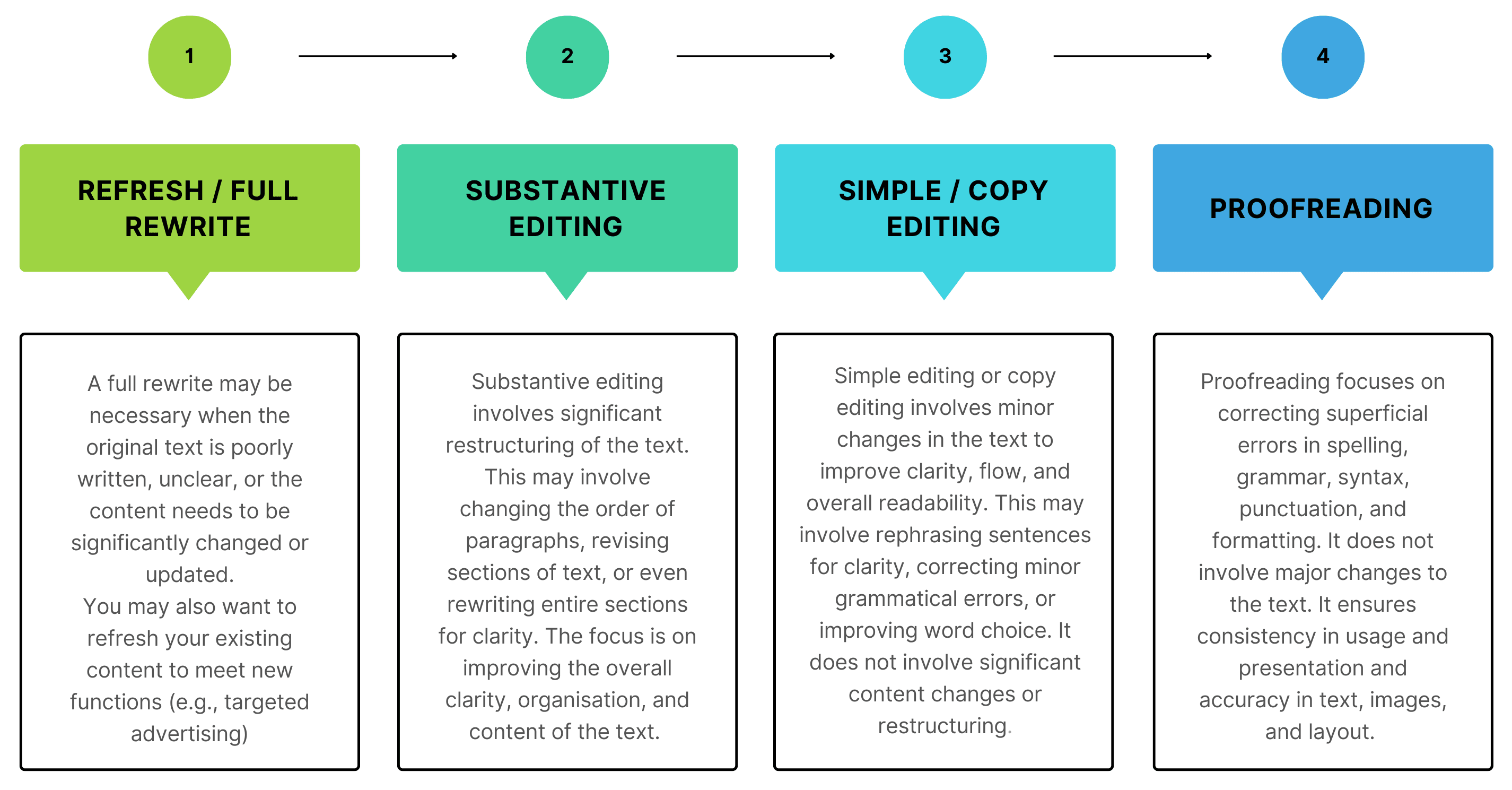
If you’re unsure which service you need, a sample review can quickly clarify the level of support required — and prevent under- or over-editing.
Editing research theses: what editors can - and cannot - do
Professional editing of research theses is governed by clear ethical standards which are outlined in the Guidelines for editing theses (updated July 2025) published by the Institute of Professional Editors (IPEd). In summary, editorial intervention must be limited and transparent. Editors may provide copyediting and proofreading, but they must not alter the intellectual content or structure of the thesis.
What editors may do
Editors can:
- improve clarity and flow of expression
- correct grammar, spelling, and punctuation
- ensure appropriate tone, style, and academic language
- check consistency of terminology, abbreviations, units, tables, and figures
- ensure references and citations conform to the specified style
- check formatting and layout consistency
Editors may also identify issues with content or structure, but only by drawing the student’s attention to them — not by correcting them.
What editors must not do
Editors must not:
- rewrite or restructure the thesis argument
- add or remove content
- check factual accuracy or plagiarism
- assume responsibility for academic integrity
If issues are identified, the editor should advise the student to consult university guidelines or their supervisor.
Why formatting matters more than you think
Strong writing can still fall short if formatting requirements are ignored. For theses, reports, and journal manuscripts, formatting is not merely cosmetic — it signals professionalism, attention to detail, and respect for institutional or publisher standards.
Theses and higher degree research
Universities typically provide detailed formatting requirements covering margins, font size, spacing, headings, pagination, tables of contents, and citation style (for example APA, Harvard, or Chicago). Supervisors and examiners expect:
- consistent formatting across chapters
- accurate page numbering and headings
- correct placement of tables, figures, and appendices
- consistent citation and referencing
An experienced editor will often check structural consistency and style compliance alongside language and clarity, helping ensure the thesis meets institutional expectations.
Journal manuscripts
Journal submissions must conform precisely to the journal’s Instructions for Authors. These commonly specify word limits, abstract structure, reference style, figure and table presentation, and even file formats.
Editors and reviewers expect manuscripts to be clean, organised, and submission-ready. Inconsistent formatting, incorrect references, or failure to follow instructions can delay review — or lead to outright rejection — regardless of the quality of the research.
Style guides and author instructions
Providing relevant style guides or journal instructions upfront allows your editor to tailor their work effectively. This ensures not only correct language but also accurate formatting, citations, and layout, saving time at later stages.
In summary
Understanding the difference between editing and proofreading can take much of the uncertainty out of preparing a document for submission. Each plays a distinct role at different stages of the writing process, and choosing the right support at the right time can improve both the quality of your work and your confidence in submitting it.
Equally important is recognising that strong writing alone is not enough. Formatting requirements for theses and journal manuscripts are not optional details - they are part of how your work is assessed and received. Consistency, accuracy, and adherence to guidelines signal care, professionalism, and respect for the reader.
When editing, proofreading, and formatting are approached thoughtfully - and in line with ethical standards - your ideas are given the best possible chance to be understood, evaluated fairly, and taken seriously.
---
Frequently Asked Questions (FAQs)
Editing vs proofreading — and why formatting matters
Q. What is the main difference between editing and proofreading?
A: Editing improves clarity, structure, tone, and flow, while proofreading is the final check for grammar, spelling, punctuation, and formatting once the content is settled.
Q. Do I need both editing and proofreading?
A: Often, yes. Editing is typically done first to refine the writing, followed by a final proofread just before submission or publication to ensure accuracy and consistency. If you need proofreading AND editing at the same time, order an editing service, as editing typically incorporates proofreading alongside improvements to clarity and flow.
Q. How do I know which service my document needs?
A: If you’re unsure about clarity, structure, or overall readability, choose editing. If the document is already polished and nearly ready to submit, proofreading may be enough. If in doubt, a sample review can help confirm the best level of support.
Q. Can you help with formatting as well as language?
A: Yes. For theses and journal manuscripts in particular, we can check formatting and consistency to help ensure alignment with university requirements or journal instructions for authors. Extra charges may apply to more complex formatting requests, so you are advised to outline your formatting requirements when requesting editing services.
Q. Will an editor change the meaning of my work?
A: No. Professional editing strengthens expression and readability while preserving your intent, meaning, and authorial voice.
Q. Is thesis editing allowed under university rules?
A: Yes, provided ethical standards are followed, as outlined in the IPEd’s Guidelines for editing theses (updated July 2025) . Editors may copyedit and proofread for language, consistency, and formatting, but must not change the content, structure, or intellectual argument of the thesis.
Choosing the right support
Editing and proofreading are complementary - not interchangeable. Selecting the right service at the right time, and respecting formatting requirements, can significantly strengthen your work and reduce stress at submission. If in doubt, seek advice early.
Contact KMG Communications for professional writing and editing services to meet your needs.
For more information on KMG Communication’s professional editing and proofreading services, refer to our page: Medical Editing and Proofreading Services
)
| Tags:Latest NewsMost Popular |