&geometry(294x90) "KMG Communications")
Beat the heat: How to play it safe when exercising in hot weather
)
Exercising in the heat presents unique challenges for athletes.
When undertaking strenuous exercise in the heat, whether that be for training or competition, athletes must take precautions to maintain their performance and personal safety. Be mindful of extreme high-temperature days. The Australian government and health authorities including Sports Medicine Australia issue specific warnings for the general public on high-temperature days - key messages include:
- Limit outdoor activities during the hottest hours
- Stay hydrated before, during and after activity
- Take frequent rest breaks and seek shade (or cool, air-conditioned environments)
- Use cooling methods such as ice towels or misting fans
- Delay or cancel play if conditions reach extreme risk levels
For athletes, outdoor training sessions on severe high-temperature days are best cancelled or rescheduled to avoid the serious consequences of overheating. This article explains why and provides you with tips on what you need to consider when exercising in the heat.
The physiological response of the body to heat
When you exercise strenuously in even moderate heat, your body’s core temperature rises. In response, your blood flow is rerouted so more of it goes to your skin surface to help your body let off your internal heat, and you break a sweat (it is the evaporation of sweat into the atmosphere that causes heat to be lost from your body, thereby providing a cooling effect).
The redirection of blood flow to the skin makes less oxygen available to your muscles and hence your heart beats faster and pumps harder to compensate for the loss of oxygen going to your muscles. This results in a higher heart rate for your usual set training pace, and you tend not to maintain the same pace that you would on a cooler day.
So, if you wear a heart rate monitor, don’t be surprised by a higher heart rate during a workout that might feel slower than usual. When training in the heat, it is better to train or run "by feel" or your level of Relative Perceived Exertion rather than by pace or time.
Symptoms of overheating during exercise
Early warning signs
- Excessive sweating
- Thirst or dry mouth
- Fatigue or unusual tiredness
- Flushed or hot skin
- Mild headache
- Muscle cramps
- Elevated heart rate
Moderate symptoms
- Dizziness or light-headedness
- Nausea or vomiting
- Weakness or clumsiness
- Difficulty concentrating or confusion
- Chills or goosebumps despite heat
- Unusually fast or strong heart rate
Severe symptoms (medical emergency)
- Cessation of sweating with hot, dry skin
- Severe headache
- Disorientation, agitation, or collapse
- Fainting or loss of consciousness
- Seizures
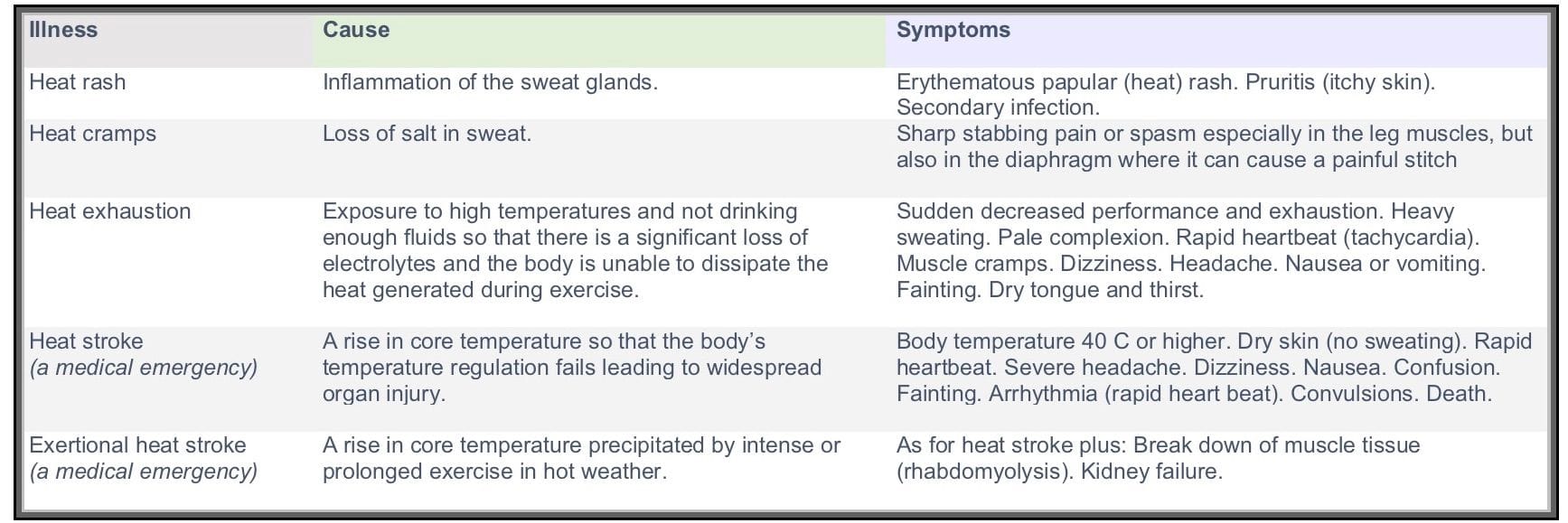
A summary of the major types of heat illness
Table 1. Types of heat illness
STOP exercise immediately if any of the following occur:
- Dizziness, light-headedness, or nausea
- Unusual fatigue or weakness
- Headache or confusion
- Muscle cramps
- Hot, flushed skin or chills/goosebumps
- Loss of coordination or unsteady movement
Any collapse in hot conditions should be treated as potential heat stroke. Call an ambulance immediately (Sports Medicine Australia guidelines).
What to do:
- Listen to your body: pay attention to how you're feeling.
- If you start to experience symptoms of overheating, stop activity, move to a cool or shaded area, begin active cooling, and rehydrate. The simple act of taking a rest in a cool or shaded area and drinking plenty of fluids can help bring down your body temperature.
- Seek urgent medical help if symptoms worsen, sweating stops, or collapse occurs.
What should you consider when exercising over summer?
Besides hydration, it is important for you to be aware of several other factors affecting your body’s ability to regulate its core temperature in terms of how much heat your body (a) generates and (b) dissipates (eliminates).
Weather: It’s a good idea to check the humidity, temperature, cloud cover and wind before going out to exercise. Elements of the weather will impact the conditions for exercising. For example, sweating is the body’s most important cooling mechanism during exercise. If the humidity is high, sweat cannot evaporate to produce a cooling effect.
Clothing: Wear light, breathable fabrics. While you may wear a cap for sun protection, be mindful that you dissipate a significant amount of heat through your head and so removing it every now and then might be a useful strategy for cooling down in hot weather.
Individual physical form: Be aware of your own health status and physical condition when exercising in the warmer weather. Modify your training appropriately and moderate your exercise intensity, as the faster you run, the more heat you will generate. It is wise to simply slow down in warmer weather and adjust your racing or training pace for the heat.
Chronic medical conditions: Exacerbation of chronic illness contributes to the majority of heat-related morbidity and mortality. Some illnesses affect the ability of peripheral vasodilation - the blood vessels in the skin may not be able to enlarge enough for heat to be released through the skin, making it difficult to control body temperature. Sometimes the heart muscle may be too weak to respond to the demands of heat, and so the heart has less reserve capacity to transport heat from the body (and is more likely to become overworked during periods of heat stress). You should take special care when exercising in hot weather if you have:
- Heart disease
- High blood pressure
- Diabetes
- Kidney disease
- Cancer
Medications: Several commonly prescribed medications can interfere with the body’s heat regulation and so increase the risk of heat-related illness. You should therefore take special care when exercising in the heat and modify your training appropriately. If you intend to follow a regular exercise program, you may need to consult your doctor and have your medicine doses adjusted in the summer months. Some physiological effects of medications to watch out for in summer are shown in Table 2.
Table 2. Physiological effects of medications
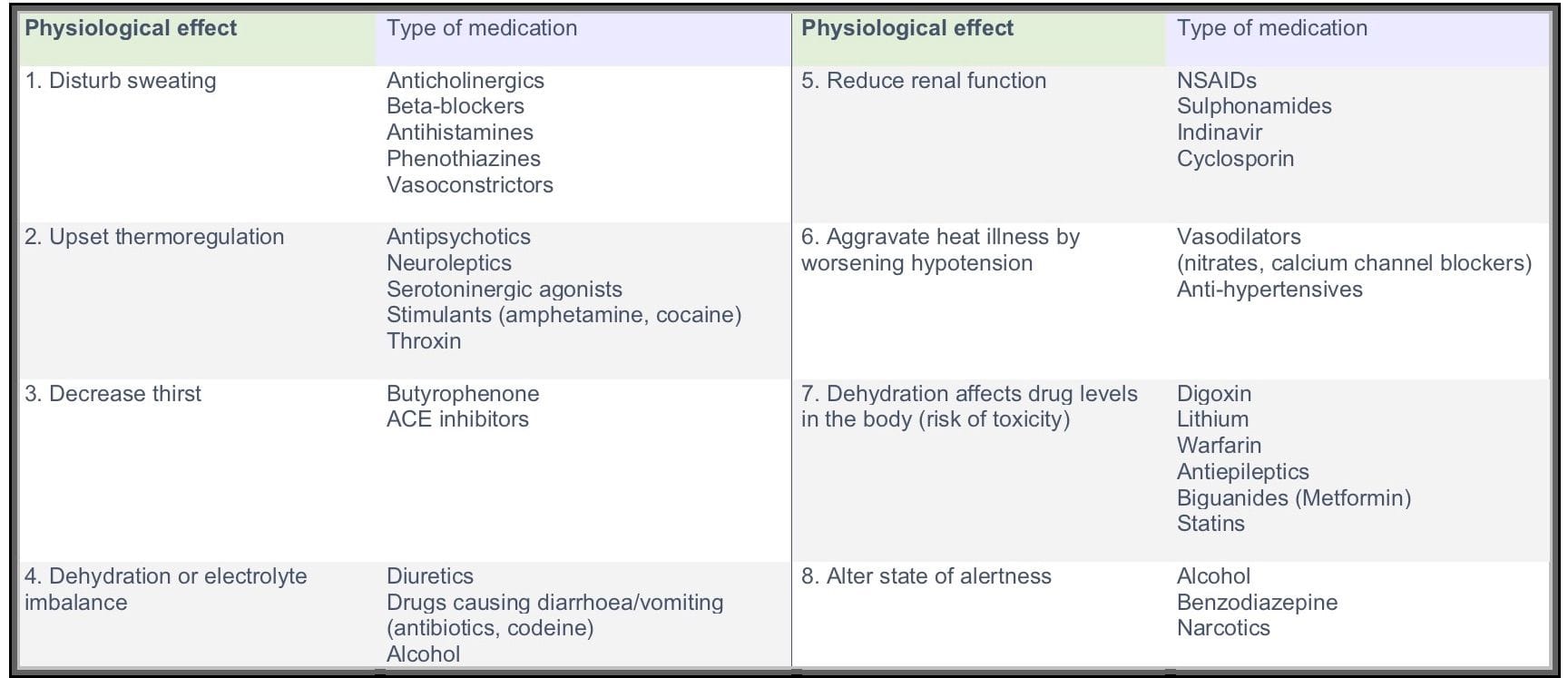
*This is not a comprehensive list and is intended only as a guide. You should always consult your doctor first for advice concerning your own medication regime.
A warning on water consumption
Stay well hydrated but be careful not to overhydrate. Drinking too much fluid can lead to hyponatremia, which is when sodium in the blood becomes too diluted. There have been occasions when athletes have tried too hard to prevent dehydration by consuming too much water even in hot weather, with dire consequences.
Conclusion
Stay mindful of the factors which can impact your performance in the heat. Listen to your body and adjust your intensity of exercise appropriately. Avoid outdoor exercise in extreme heat conditions. Play safe and well in summer!
---
Frequently Asked Questions (FAQs)
Beat the heat: How to play it safe when exercising in hot weather
Athlete-focussed FAQs
Q. Are athletes underestimating how much heat impacts performance?
A: Often, yes. Heat is frequently treated as a secondary factor, but it can be a primary limiter of performance, significantly increasing cardiovascular strain and accelerating fatigue.
Q. Is pushing through the heat a sign of toughness—or a risk?
A: It can be both. While mental resilience matters, ignoring physiological stress in hot conditions can increase the risk of heat illness and compromise both performance and safety.
Q. Why can performance drop so suddenly in hot conditions?
A: As core temperature rises, the body prioritises cooling over performance. This shift can rapidly reduce power output, endurance capacity, and decision-making ability.
Q. Are experienced athletes protected from heat-related issues?
A: No. Even highly trained athletes can be affected, particularly if they are not acclimatised or underestimate hydration and pacing strategies in hot conditions.
Q. Is dehydration the main problem—or just part of the picture?
A: Dehydration is important, but it is only one factor. Heat stress also involves cardiovascular load, thermoregulation, and environmental conditions, all of which interact to influence performance and risk.
Clinically focussed FAQs
Q. What are the key physiological challenges athletes face in hot environments?
A: Heat exposure increases cardiovascular strain, as blood is redistributed to support thermoregulation while maintaining muscle perfusion, alongside rising core temperature and fluid loss.
Q. How should clinicians assess risk of heat-related illness in athletes?
A: Risk assessment should consider environmental conditions, level of heat acclimatisation, hydration status, training intensity, and individual factors such as comorbidities or recent illness.
Q. What are the early clinical signs of heat-related illness?
A: Early signs include fatigue, dizziness, nausea, headache, and muscle cramps, which may progress to confusion, collapse, or central nervous system dysfunction in more severe cases.
Q. What immediate management steps should be taken if heat illness is suspected?
A: Prompt cooling is critical. Remove the athlete from the heat, initiate active cooling (e.g. cold water immersion if available), rehydrate, and escalate care if there are signs of heatstroke or neurological impairment.
Q. How should return to training be managed after heat-related illness?
A: Return to activity should be gradual and guided by clinical recovery, with attention to rehydration, re-acclimatisation, and modification of training load to reduce recurrence risk.
---
References
Casadio, J.R., Kilding, A.E., Cotter, J.D. et al. (2017). From lab to real world: Heat acclimation considerations for elite athletes. Sports Medicine 47, 1467-1476 (2017). https://doi.org/10.1007/s40279-016-0668-9
Gibson, O. R., James, C. A., Mee, J. A., Willmott, A. G. B., Turner, G., Hayes, M., & Maxwell, N. S. (2019). Heat alleviation strategies for athletic performance: A review and practitioner guidelines. Temperature, 7(1), 3-36. https://doi.org/10.1080/23328940.2019.1666624. https://www.tandfonline.com/doi/full/10.1080/23328940.2019.1666624
Guy, J. H., and G. E. Vincent (2018). Nutrition and supplementation considerations to limit endotoxemia when exercising in the heat" Sports 6, 1: 12. https://doi.org/10.3390/sports6010012
Linberg, S. (2018). What can RPE tell us about exercise? Healthline. https://www.healthline.com/health/RPE
Sawka MN, Wenger CB. 1993. Physiological responses to exercise in the heat (Ch. 3). In: Institute of Medicine (US) Committee on Military Nutrition Research; Marriott BM, editor. Nutritional needs in hot environments: Applications for military personnel in field operations. Washington (DC): National Academies Press (US). Available from: https://www.ncbi.nlm.nih.gov/books/NBK236240/
Sports Medicine Australia. Hot weather. https://sma.org.au/resources/policies-and-guidelines/hot-weather/
)
| Tags:Heart Health for Athletes |